Data Driven David

2025 fantasy football champion

The Data Behind My 2025 NFL Fantasy Football Championship

Reading Time: 11 minutes

An honest, data-driven breakdown of how lineup decisions, depth, and adaptability shaped a championship season.

Reader Beware: Any blog post tagged as “Data Driven David” may not be as related to marketing as most of my content. I truly love data and love it even more when it is well visualized and wrapped in a great story — now, that’s good marketing.

Season Summary

This article is a full data-driven breakdown of how I won my 2025 NFL fantasy football league. Instead of focusing on rankings or projections, it analyzes what actually happened week after week across the season, including draft capital, weekly lineup decisions, bench mistakes, and positional risk management.

Using week-by-week scoring data, I reviewed every major roster decision to see not just whether I won, but how efficiently I made those decisions. In some cases, I left significant points on the bench. In others, I built enough depth and flexibility to survive injuries and small mistakes without damaging my season.

The goal of this analysis is to identify where my process was strong, where it was weak, and what lessons can be applied to future fantasy football seasons. If you are looking for a real-world example of how data driven fantasy football decisions impact results, this page shows it in detail.
So after the confetti settled, I did not just enjoy the win. I went back and pulled the data to see what actually happened. Not just who I drafted, but what every major lineup decision and bench choice really cost me over the course of the season.

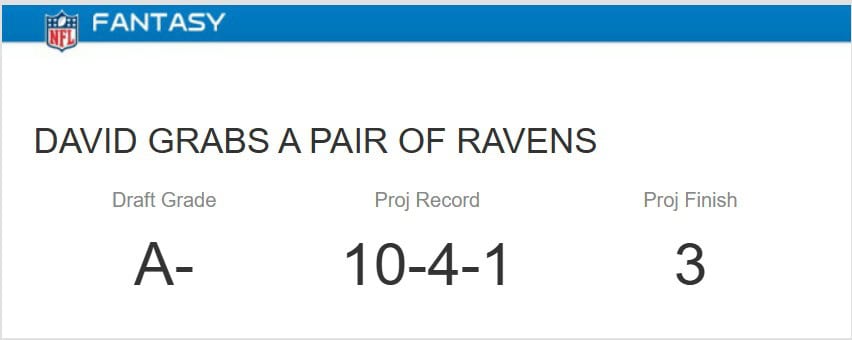
You can see in the image below that I got an A- for my draft and was projected to finish 3rd. The draft summary said the following:


David will be a team with upside this season. Drafting fifth overall, they assembled a roster with playoff potential. They added some running backs early, using three of their first five picks on ball-carriers. Going hand-in-hand with that early investment, David secured the best foursome of running backs in the league.
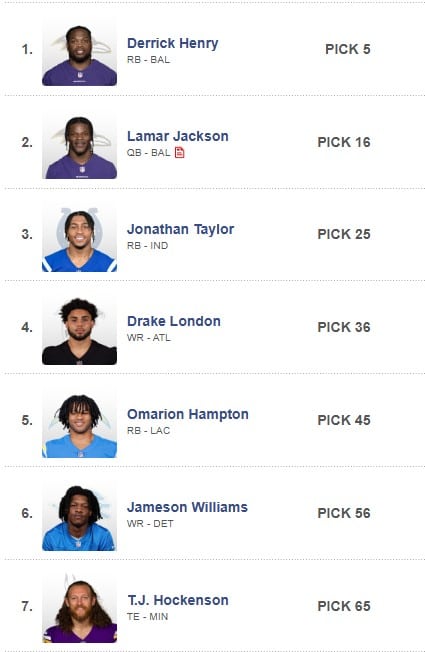
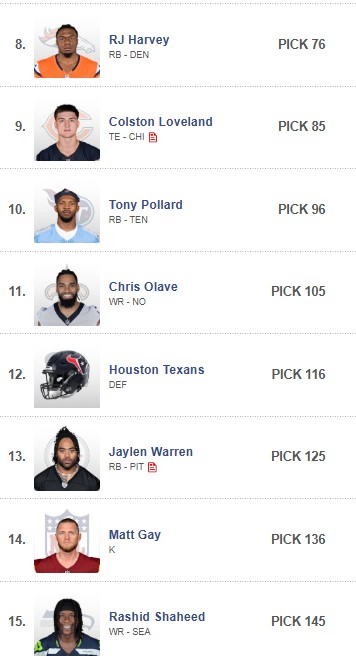
Here are the players I drafted:
I actually finished 4th and like most teams had many frustrating injury setbacks along with other frustrations around inconsistent performance, basically life happened. I swap out players more often than most, whether that’s too take advantage of a short-term injury or to find a rising star before it’s obvious to others. The chart below shows the weekly points I accumulated and if that resulted in a win or loss. The loss by 0.8 points still stings a little. Weeks 16 and 17 were playoffs.
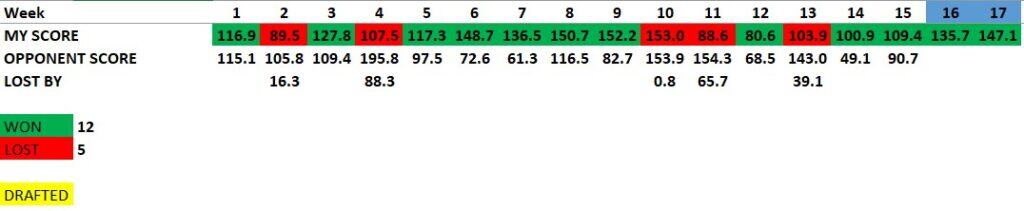
TL;DR: I won my 2025 NFL fantasy football league by building depth, minimizing catastrophic mistakes, and using data to evaluate decisions instead of trusting gut feel. This article breaks down exactly how that happened, position by position.

Here is an analysis by position of what I did and what I learned.

Quarterback: When Loyalty Beat Logic

During the 2025 NFL fantasy football season, I believed I had my quarterback position locked down. I drafted Lamar Jackson, trusted my instincts, and treated the position as mostly rinse and repeat.
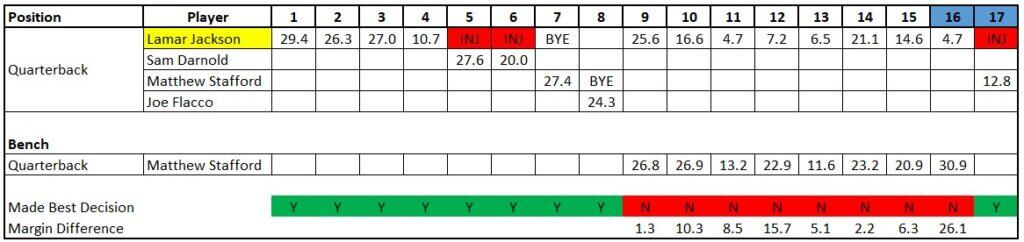
This chart shows not just who I started at quarterback each week, but how many fantasy points I lost by not starting the best available option.

What I did not realize until I analyzed the data after the season ended was that I benched the number three fantasy quarterback for eight straight weeks. That quarterback was Matthew Stafford.

Once I laid out the weekly scores, the pattern was impossible to ignore. While Lamar delivered a mix of strong performances, injuries, and volatility, Stafford quietly produced steady QB1 numbers from my bench. From Weeks 9 through 16, Stafford outscored my starting quarterback in seven of eight weeks, often by double-digit margins.

In other words, the data was telling me to start Stafford for nearly half the season, and I ignored it.

What Went Wrong

Sunk cost fallacy: I stayed committed to Lamar largely because of draft capital and preseason belief. Instead of asking which quarterback gave me the best chance to score the most points this week, I defaulted to the one I felt I was supposed to start.

Gut over data: Stafford was not a one-week fluke. He delivered sustained, high-level production for nearly two months. At some point, trusting my gut stopped being intuition and became stubbornness.

Decision quality versus results: There were weeks I won despite making the wrong quarterback decision. That is the most dangerous kind of feedback, because it rewards a broken process and encourages you to repeat it.

The core lesson is not about Lamar Jackson or Matthew Stafford. It is about process. The data that would have improved my lineup was already on my roster. I just failed to look at the data.

Going forward, the rule is simple. When the data consistently disagrees with my gut, my gut is the thing that belongs on the bench.

Running Back and Flex: How Depth Turned Risk Into Stability

The 2025 NFL fantasy football season reinforced one of my core roster-building beliefs: you can never have too many startable running backs. Between traditional RB slots and the W/R flex, I leaned heavily into the position, fully expecting that at least one of my top backs would get injured.
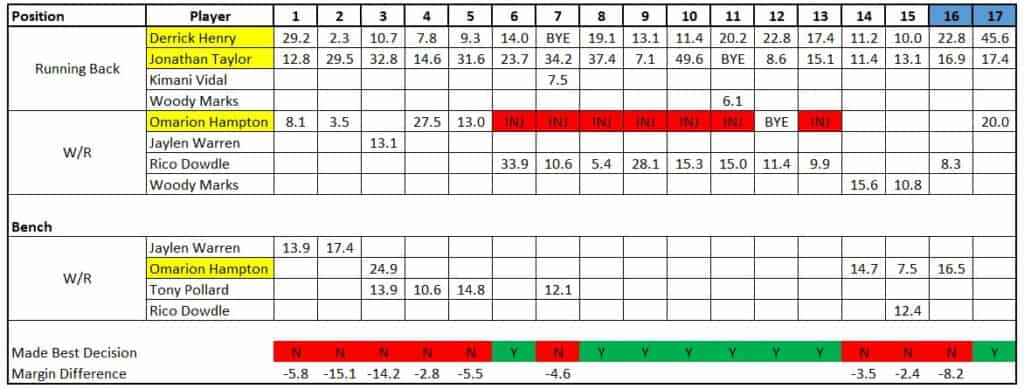
This chart shows how my running back and flex decisions compared to the best possible lineup each week and how depth kept most mistakes small.

That expectation proved correct when Omarion Hampton, a high-upside rookie I selected in the fifth round, missed most of the season. What mattered was not the injury itself, but how well the roster absorbed it.

Because Derrick Henry and Jonathan Taylor anchored the position and players like Jaylen Warren, Rico Dowdle, and Tony Pollard provided weekly depth, the running back room never collapsed. Even when I did not always start the optimal combination, the drop-off was usually small. Most weeks, the difference between my starter and my best bench option was only a few points.

That is the difference between a fragile roster and a resilient one.

What Worked

Built-in injury protection: Running backs get hurt. By drafting multiple players who could realistically be started in any given week, I turned an inevitable injury into a manageable inconvenience rather than a season-ending event.

Low-cost mistakes: The data shows that while I often benched a slightly better option, only two weeks produced a meaningful scoring gap. Those were acceptable errors. Small mistakes do not sink a season when the underlying roster is strong.

Flex as a floor play: I frequently used running backs in the W/R flex. That sacrificed some upside, but it increased weekly stability. Touch volume is more predictable than wide receiver targets, and over a full season, that consistency adds up.

The key lesson from the running back position is that success was not driven by perfect lineup decisions. It was driven by structural design. I built redundancy, accepted injury risk, and avoided catastrophic downside.

Wide Receiver: Thin Depth, One Costly Miss, and an Unexpected Anchor

Wide receiver was the position where I carried the least depth in 2025. I did not roster many extra options, which meant I was relying heavily on my top two starters to deliver, and I was mostly hoping a third receiver would emerge over time.
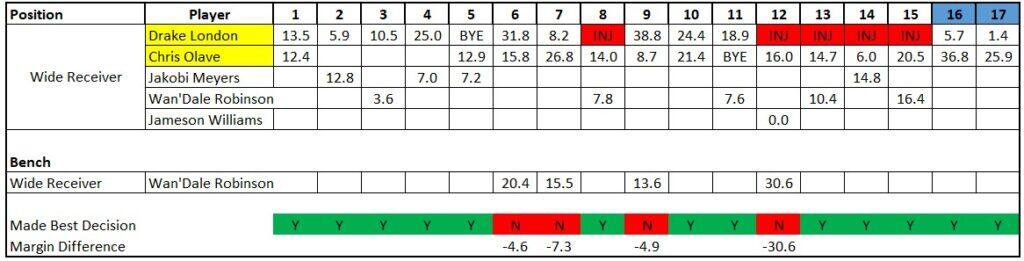
This chart shows when my wide receiver choices were optimal and highlights the one week where a bench player dramatically outperformed my starter.

The good news is that Chris Olave outperformed what I expected and gave me a steadier weekly contribution than I anticipated. That mattered, because Drake London was productive early but became difficult to rely on later due to missed time. With limited depth behind them, the wide receiver room was functional, but it was not built to absorb much disruption.

From a lineup decision standpoint, this position was not a weekly problem. I usually made the right call, and the data shows that most weeks the difference between my starter and my bench option was small. However, there was one week where the choice mattered a lot. Wan’Dale Robinson erupted on my bench, creating a major missed opportunity. That single decision stands out because it was not a two-point regret. It was a game-changing swing.

What Worked

A reliable top two: Olave playing above expectations stabilized the position. Even without a consistent third receiver, having two startable options most weeks kept wide receiver from becoming a weekly scramble.

Mostly correct decisions: Unlike quarterback, wide receiver did not show a pattern of repeated benching mistakes. The process was generally fine, and most decision margins were not large enough to reshape outcomes.

What Did Not Work

One costly bench miss: The data shows one clear week where a bench receiver massively outscored the starter. That was the downside of carrying limited depth. When a bench player spikes and you do not start them, there is no built-in protection.

No true third option: I never fully landed on a dependable WR3. The rotating options provided occasional points, but not enough consistency to feel like a solved position. In practice, the third receiver spot stayed more like a weekly placeholder than a reliable role.

The main lesson at wide receiver is that this group succeeded more because the top two held up than because the room was deep. The process was generally solid, but the structure was thin. Next season, even one additional credible wide receiver would reduce the risk of another week where a single bench eruption becomes a season-defining regret.

Tight End: A Slow Start, Draft Regret, and a Late-Season Recovery

Tight end was the one position in 2025 where I felt immediate draft regret. I invested in T.J. Hockenson expecting weekly stability, but early in the season that never materialized. The position produced little more than replacement-level output for weeks, forcing me to rotate through Juwan Johnson, Dallas Goedert, Orodne Gadsden, and Harold Fannin just to stay afloat.
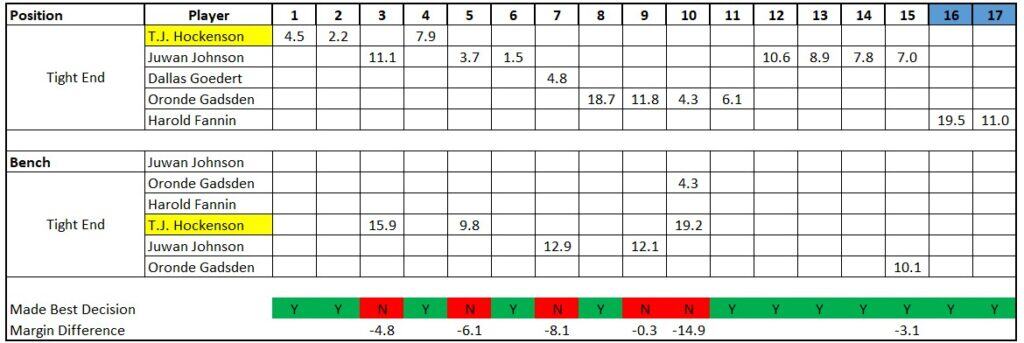
This chart shows how often my tight end start was the best available option and how streaming kept losses manageable despite draft disappointment.

From a match up standpoint, this was not a catastrophic failure, but it was a drag on weekly scoring. Even when I made the correct start, the points were often modest. The position rarely lost me a week outright, but it also rarely helped me win one.

The encouraging trend is that tight end production became more reliable late in the season. As Fannin and Gadsden emerged and usage stabilized, the weekly floor improved. By the time the playoffs arrived, I was finally getting consistent contributions instead of guessing between low-ceiling options.

What Went Wrong

Draft capital without return: Hockenson never became the weekly difference-maker his draft cost implied. That forced me into streaming mode early and removed the positional advantage I was hoping to gain.

Early-season instability: Rotating tight ends meant I was often choosing between players with similar low projections. Even when the decision was technically correct, the output rarely felt satisfying.

What Worked

Late-season stabilization: As the season progressed, Fannin and Gadsden gave me a more predictable scoring floor. The data shows fewer major misses in the second half of the season compared to the early weeks.

Limited damage: Despite the draft disappointment, this position did not sink the season. Most weeks, the margin between my starter and my best bench option was small, which kept tight end from becoming a true liability.

The lesson at tight end is that draft mistakes do not have to be fatal if the position is managed aggressively. I did not get the advantage I wanted, but I also did not allow the problem to spiral. By adapting and streaming until something stuck, the position eventually became stable enough to support a championship run.

Kicker: Low Risk, Minimal Drama, and a Set-It-and-Forget-It Finish

Kicker was the least eventful position on my roster in 2025, and that is exactly how it should be. I drafted Chase McLaughlin, briefly pivoted when Spencer Shrader was injured, and then returned to McLaughlin for the rest of the season.

This chart shows weekly kicker production and why carrying only one kicker created minimal risk and little opportunity cost.

Unlike the other positions, kicker carries very little strategic upside. Weekly swings are small, and the replacement level is high. Because of that, I usually carried only one kicker and treated the position as low risk. If something went wrong, the fix was easy.

That approach paid off. Once I moved back to McLaughlin, the position became stable enough to ignore. The scores were not spectacular, but they were good enough, and more importantly, they did not introduce unnecessary lineup stress.

The lesson here is simple. Not every position needs to be optimized. Some positions just need to be managed cheaply and kept out of the way while you focus on decisions that actually move the needle.

Defense: Streaming for Match-ups and Riding Late-Season Momentum

Defense was a position I treated as fluid all season. Rather than committing to one team, I consistently streamed defenses based on match up, looking for situations where a unit could pressure the quarterback, force turnovers, or take advantage of a struggling offense.

This chart shows how streaming defenses based on match up produced steady results and improved as the season progressed.

That approach shows up clearly in the data. I rotated through multiple defenses, including the Steelers, Packers, Lions, Colts, Patriots, Buccaneers, and Texans, always aiming to align my starter with the most favorable match up available that week.

One of the defining traits of fantasy defenses is that they tend to get stronger as the season progresses. Schemes tighten up, young players settle into their roles, and teams fighting for playoff spots play with more urgency. By the time the Texans became my primary option late in the season, the position had stabilized into something I could trust rather than guess at.

Streaming does not guarantee weekly dominance, but it dramatically improves the odds of catching big defensive performances when they matter most. Instead of being stuck with a weak matchup, I kept the position flexible, which allowed me to capitalize when the right opportunity appeared.

The takeaway is that defense does not need to be drafted as a long-term commitment. It needs to be managed as a weekly opportunity. By staying aggressive and match up-focused, this position quietly became another steady contributor to the championship run.

Season Summary

This article is a full data-driven breakdown of how I won my 2025 NFL fantasy football league. Instead of focusing on rankings or projections, it analyzes what actually happened across the season, including draft capital, weekly lineup decisions, bench mistakes, and positional risk management.

One of the things that always fascinates me about fantasy football is how quickly people give up when a star player gets injured. But injuries, bad weeks, and unexpected setbacks are not flaws in the game. They are the game. The real test is not whether things go perfectly, but how well you adapt when they do not.

Using week by week scoring data, I reviewed every major roster decision to see not just whether I won, but how efficiently I made those decisions. In some cases, I left significant points on the bench. In others, I built enough depth and flexibility to survive injuries and small mistakes without damaging my season.

The goal of this analysis is simple. Identify where my process was strong, where it was weak, and what lessons can be applied to future fantasy football seasons. If you are looking for a real-world example of how data driven fantasy football decisions impact results, this page shows it in detail.

The Data Behind My 2025 NFL Fantasy Football Championship Read More »
2025 goodreads 01

Best Marketing and Business Books in 2025

Reading Time: 3 minutes

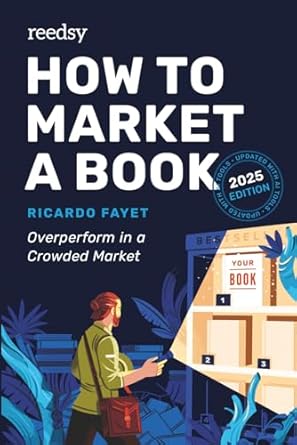
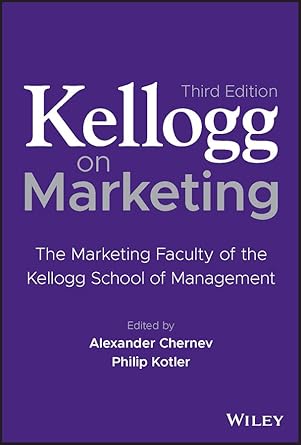
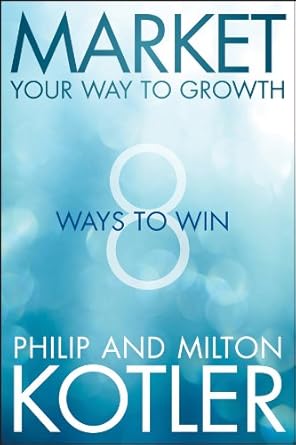
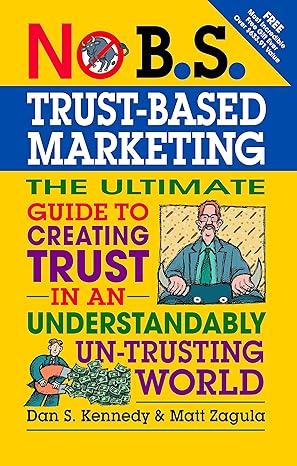
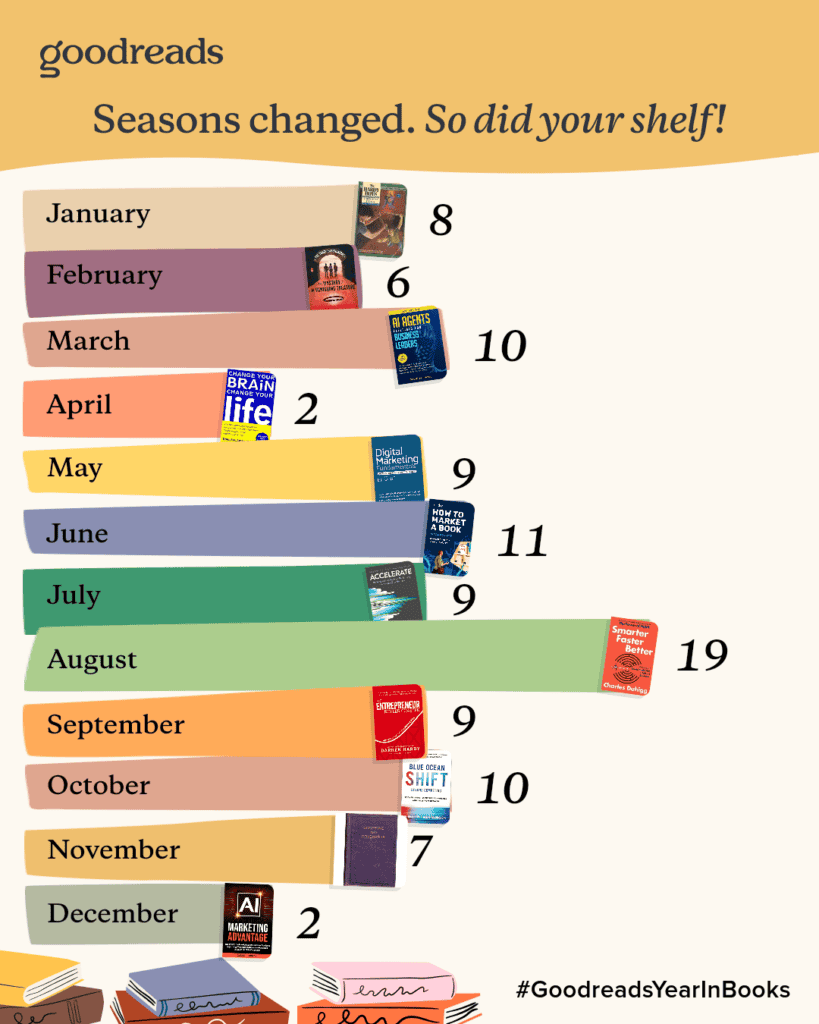
This web page highlights the 21 marketing and business books I read in 2025 that earned a five-star rating. These books focus on topics like marketing strategy, customer experience, leadership, data, analytics, and emerging technology, and they reflect the ideas and frameworks I found most useful throughout the year. The list below includes the full set of five-star reads, along with cover images and links for easy reference.

Goodreads Year in Review

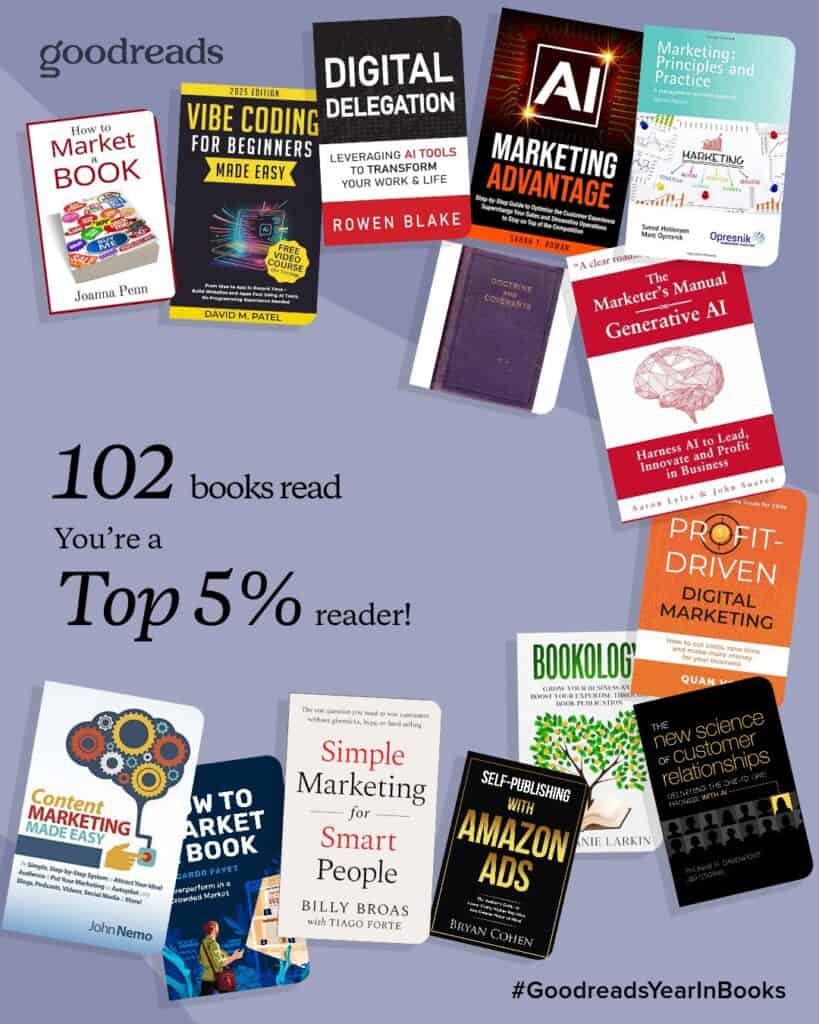
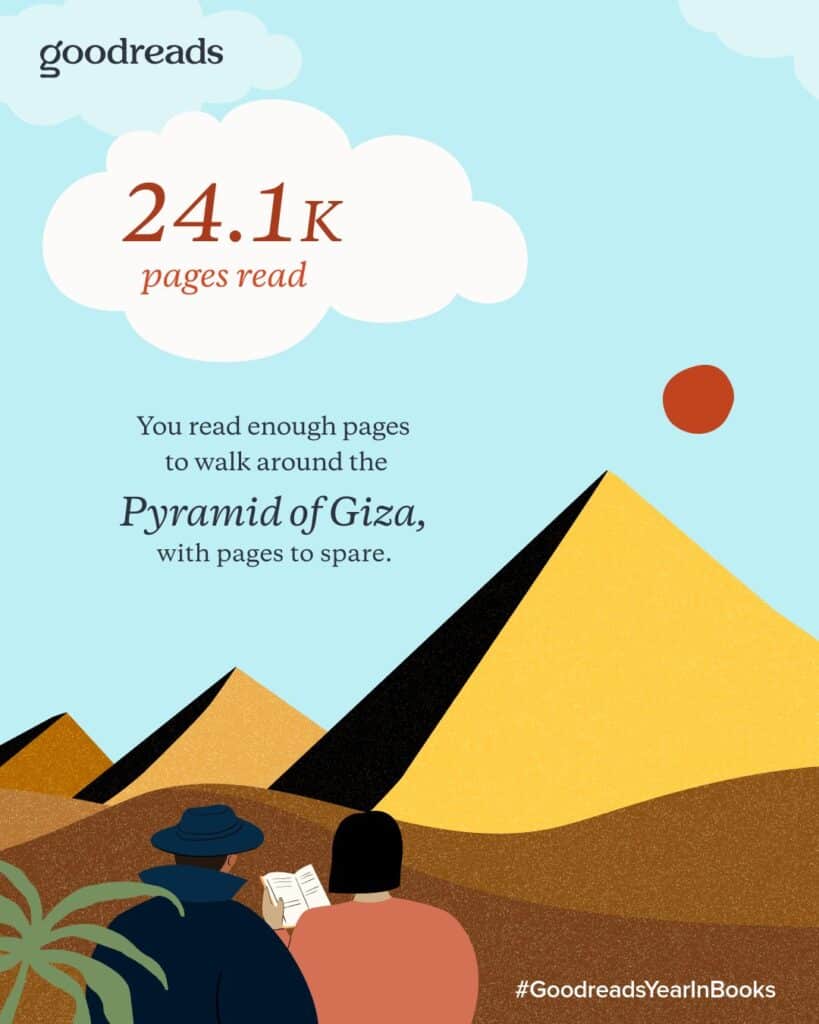
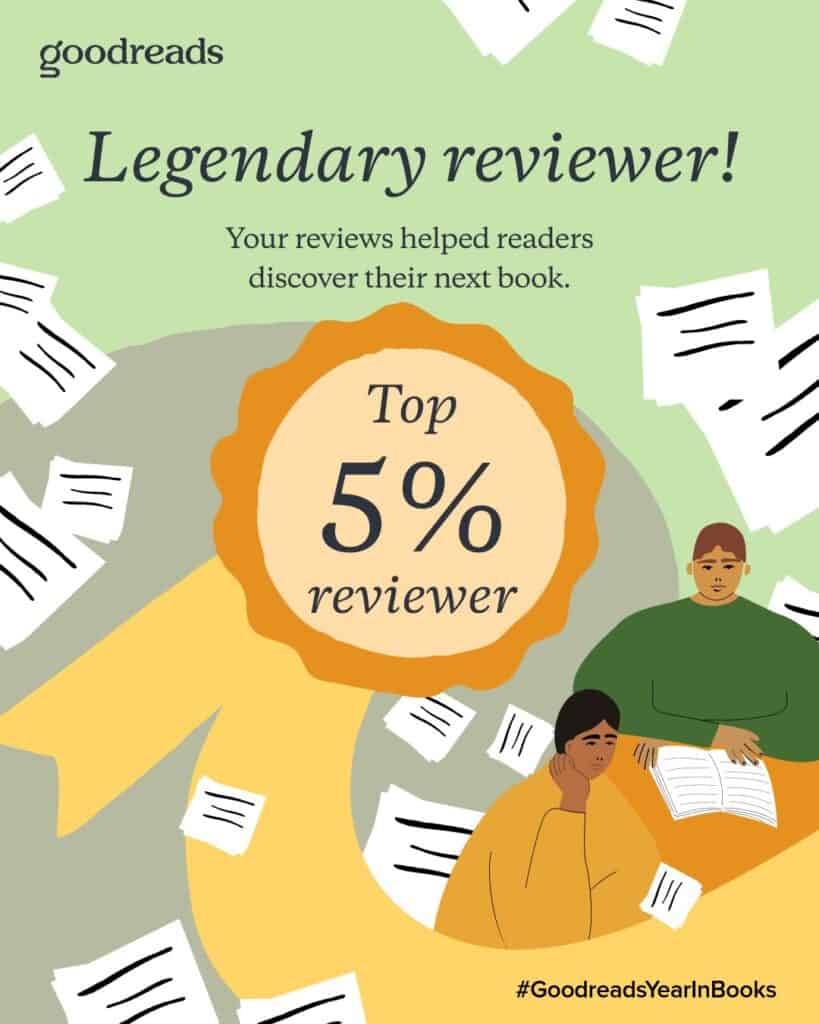
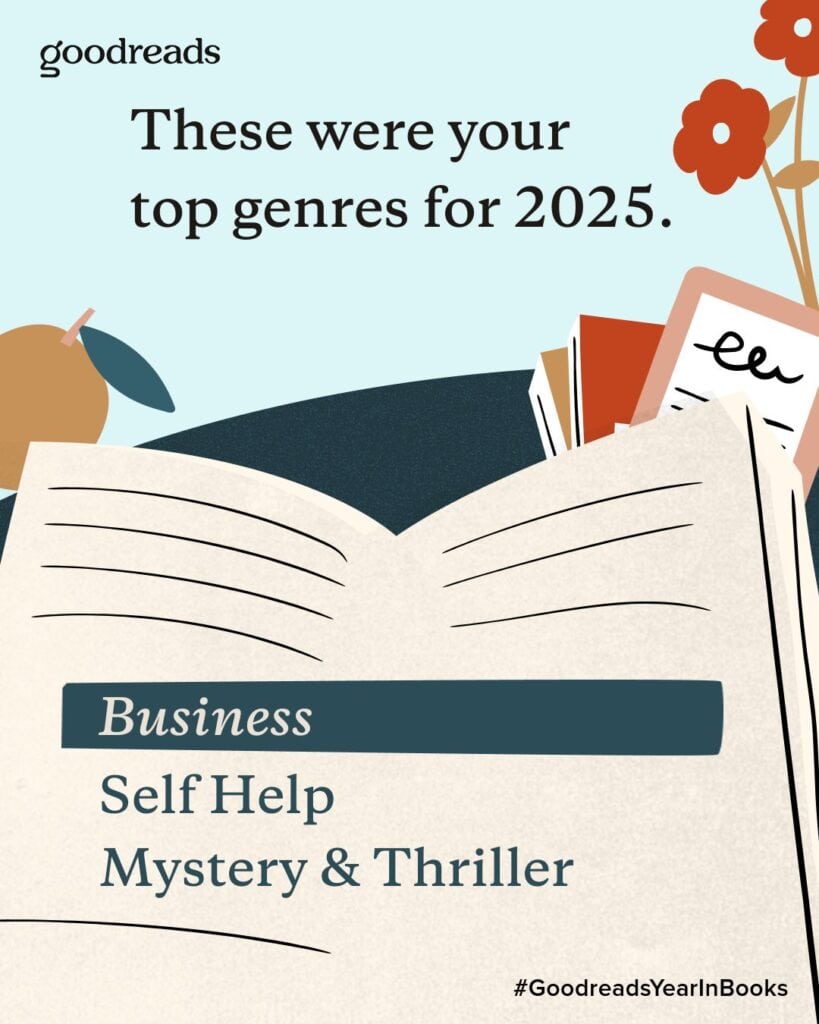
Below is my Goodreads Year in Review for 2025. It provides a quick snapshot of my reading volume, habits, and the types of books I spent the most time with throughout the year.

Best Marketing and Business Books in 2025 Read More »
business book proofreading services

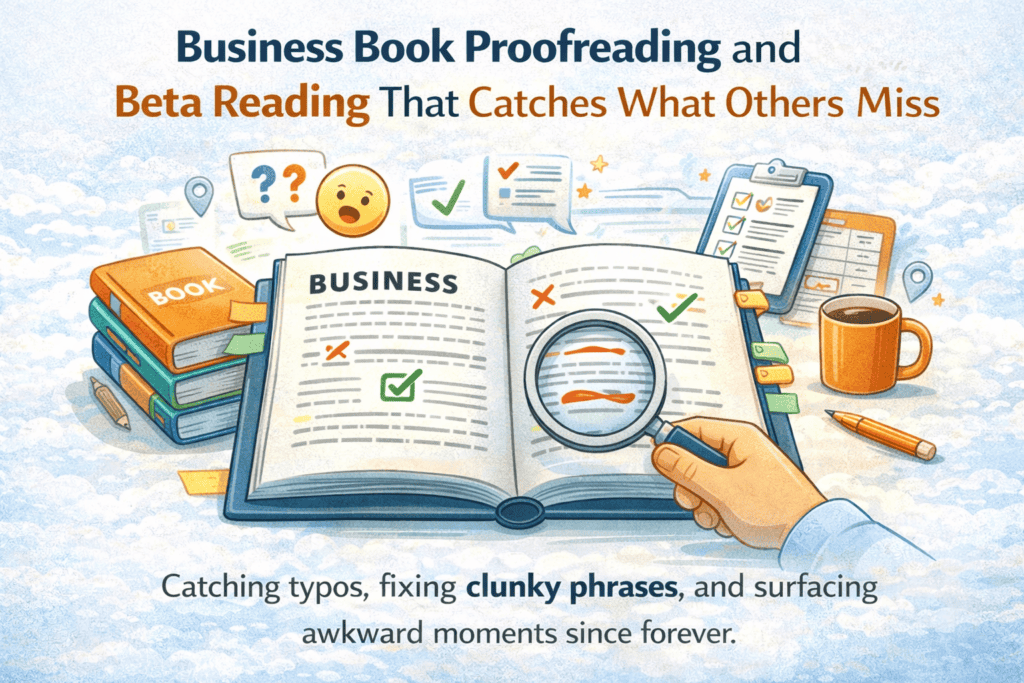
Business Book Proofreading and Beta Reading That Catches What Others Miss

Reading Time: 2 minutes

Why Authors Trust Me to Catch What Others Miss

When I am reading a book, I cannot help but spot typos, clunky phrases, inconsistencies, and places where clarity could be improved. Most people skim past these things. I notice them immediately and I have done it my whole life in books, websites, and marketing materials.

Why Work With Me as a Non-Fiction Proofreader

Active non-fiction reader: I have read more than 1,000 books, with most focused on business and marketing. I know the genre, the patterns readers expect, and where manuscripts often lose clarity.

Marketing and QA background: Years in digital marketing and software testing trained me to find what is off and explain why. My notes go beyond grammar to structure, flow, consistency, and reader experience.

The ADHD advantage: My brain happily locks onto details others miss. Authors have told me my feedback surfaced issues that other reviewers and early readers did not mention.

What I Offer Right Now

I provide friendly, helpful proofreading and reviewer feedback for non-fiction books, especially business and marketing. I am happy to read advance copies in exchange for early access and the chance to help you put out your best possible work.

No tiers or pricing packages for now. If you want a simple, honest read with practical notes you can use, I am your person.

Proofreading in the Wild

I document interesting errors and marketing misses I spot. A few recent examples:

Grammar Fails

Marketing Fails

I have hundreds of these saved and recently started posting them to Pinterest. This is the same eye I bring to your manuscript.

What I Love to Read

If you write in these spaces, we will be a great fit. Here are boards of books I rated five stars:

Five-Star Leadership Books

Five-Star Marketing Books

Five-Star Psychology Books

Five-Star Religious Books

Five-Star Spiritual Books

How We Can Work Together

If you’d like me to proofread or beta read your non-fiction book, reach out here – contact Dave. Just send me a quick note about your book and we can go from there.

Preferred format: Kindle (epub) files work best because I can highlight directly and capture screenshots as I go. I can also work with Word or PDF if that’s what you have.

Turnaround: I typically return a full read with feedback within two weeks. You’ll get my notes along the way as I am reading, so you see both real-time reactions and end-to-end feedback.

Business Book Proofreading and Beta Reading That Catches What Others Miss Read More »
a free permanent read it later system

Stop Losing Articles: A Free, Permanent Read-It-Later System

Reading Time: 4 minutes

On May 22, 2025, Mozilla announced that Pocket would shut down on July 8, 2025, with data export available until October 8, 2025.

Like many readers, I had years (and thousands) of articles in Pocket. When the shutdown notice hit, I went looking for a replacement and discovered what I actually needed from a read-it-later system.

My must-haves

  • Permanent copy, offline: not just cached, but a file I own that survives if the web page changes or disappears.
  • Free: at least for the core workflow; I was not looking to pay a subscription this time.
  • Mobile-first: most of my saving and reading starts on my phone.
  • Easy highlighting and a clean reading experience.
  • Organization: simple folders or tags for organization and to find things later.
  • (Nice to have) Voice: hear articles read aloud.

The search (a lot of apps, a lot of dead ends)

I tried a long list of apps in the stores and brainstormed with LLMs about edge cases and workflows. Many tools were great readers but failed my permanent copy test on the free tier. Some felt risky due to slow development, and others were more complex than I wanted.

The solution I landed on

I stopped chasing another service and went native:

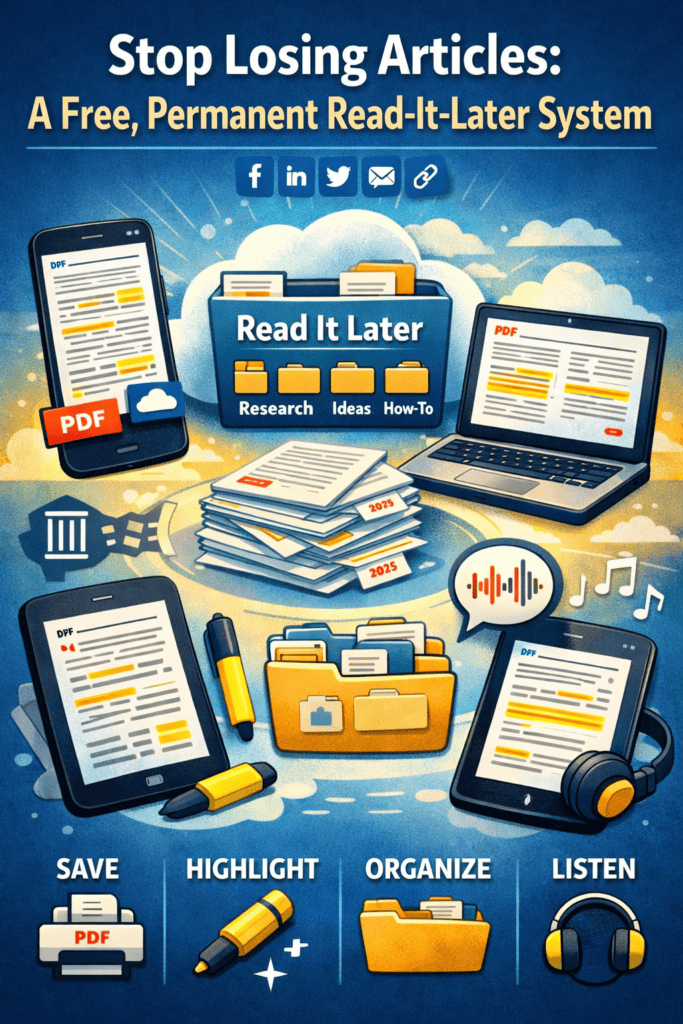
Save to PDF -> Store in a cloud folder -> Highlight in a standard reader.

  • Permanent: each saved article becomes a PDF I own.
  • Portable: I keep them in one cloud folder (I use pCloud) with subfolders by topic or by year and month.
  • Readable and highlightable: opening the PDF in Apple Books makes highlighting easy; annotations are saved in the file.
  • Voice: on iPhone, Speak Screen can read any open PDF aloud; I can also open in Books and use Speak Screen there.

How I save on phone (two taps)

  1. Share menu in the browser -> Print -> pinch out the preview -> Save to Files -> my Read It Later folder.
  2. If I want to highlight immediately, Open in Books.

How I save on laptop

  • Print -> Save as PDF to the same cloud folder.
  • For a pixel-perfect offline copy, I may also save an HTML snapshot with the SingleFile browser extension, but the PDF is my forever copy.

Moving years of Pocket links

I exported my Pocket data as a CSV and asked an LLM to help automate turning thousands of saved links into permanent PDFs. It produced a small local tool that runs on my computer: a Node.js script that opens each URL in headless Chrome (Puppeteer), extracts a clean article view with Mozilla Readability, sanitizes the HTML, and prints a tidy PDF directly into my cloud folder. No servers and no third-party accounts.

What the LLM built

  • Tech stack: Node.js, Puppeteer (headless Chrome), @mozilla/readability for clean article content, sanitize-html for safety, plus csv-parse, slugify, and yargs.
  • CSV aware: points at the Pocket CSV, detects the URL column, and can skip archived rows (I skipped anything marked “archive” in column E).
  • PDF only: a switch to write PDFs only so the folder stays clean.
  • Wayback fallback: if a page is gone or shows a “Just a moment…” interstitial, it pulls the closest Internet Archive snapshot and saves that instead.
  • Filename template: I set filenames to the article title only.
  • Resume friendly: start and limit options let me continue where I left off or process in batches if my laptop sleeps.
  • Reporting: a JSON report lists successes and any failures, plus a tiny triage script to print URLs to retry.

The result: a neat archive of permanent, highlightable PDFs in my cloud drive. For dead links, the Wayback fallback rescued many of them. Manual saving is fine for small libraries, but automation made a large migration realistic.

What I learned (and wish I had known sooner)

  • Offline is not the same as permanent. Many apps cache articles, but if the source page changes or disappears, your copy can break. A file you control (PDF or HTML) is the safest bet.
  • Own your library. Standard formats, plain folders, and a cloud drive you already use beat lock-in.
  • Highlighting matters. PDFs in Books are easy to mark up and the annotations stay with the file across devices.
  • Voice is built in. System text-to-speech like Speak Screen on iOS can read PDFs without a subscription.
  • Services come and go. Pocket’s shutdown reminded me to choose workflows that survive app closures.

My current setup (feel free to copy it)

  • Capture: Print to PDF from phone and laptop into /Read It Later on my cloud drive.
  • Organize: subfolders like Research, Ideas, and How-To, or year and month (for example, 2025/08). Filenames are the article title.
  • Read and mark up: open in Apple Books for highlights and notes.
  • Listen: use Speak Screen to read any open PDF aloud.
  • Search: system search finds titles and often PDF text; the folder structure covers the rest.

Why this works for me

It is simple, durable, and free. I do not worry about an app’s future, and I do not lose articles when the web changes. I can still use read-it-later apps as inboxes if I want, but the keepers live in my own archive.

Stop Losing Articles: A Free, Permanent Read-It-Later System Read More »
My Goodreads Data Story: Dashboards, an Interactive Chart, and 5-Star Recommendations

Reading Time: 2 minutes

Reader Beware: Any blog post tagged as “Data Driven David” may not be as related to marketing as most of my content. I truly love data and love it even more when it is well visualized and wrapped in a great story — now, that’s good marketing.

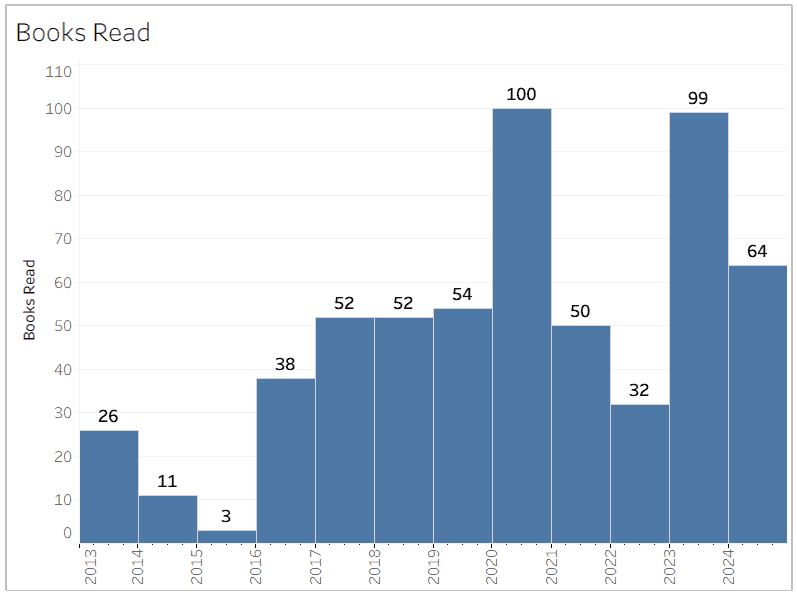
Since 2013, I’ve been tracking every book I’ve read in Goodreads. It’s been a fun way to look back on years of reading, especially since probably 80–90% of what I pick up is business-related, usually focused on marketing. In this post, I’m sharing some of my favorite charts and stats that highlight my reading habits over time. Whether you’re curious about how many books I’ve tackled or how many pages I’ve turned, you’ll find the details here.

If you’re interested, I’ve also put together a few Pinterest boards showcasing the books I’ve rated five stars across different genres:

Despite what the chart below shows, I know I’ve reached my goal of reading 100 books in a year twice. My oldest daughter would probably dismiss this achievement since most of them were audiobooks.

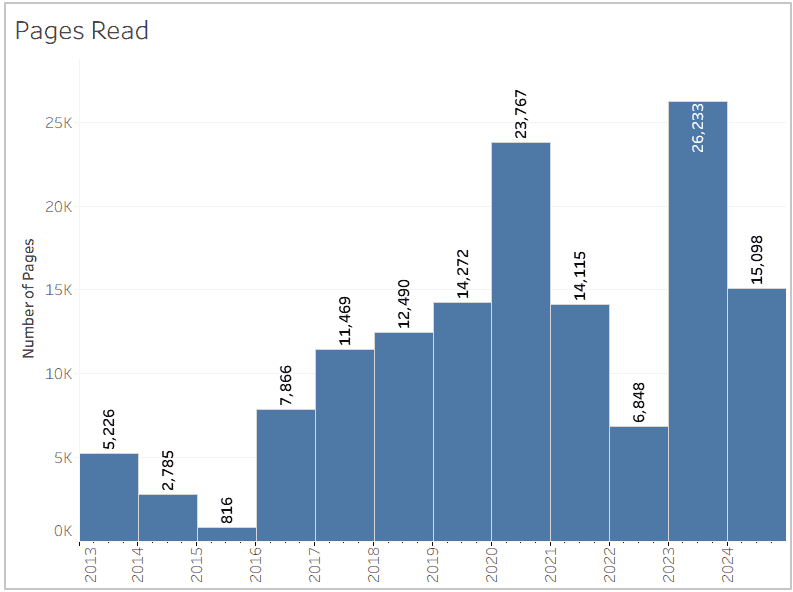
This next chart is similar, but instead of showing the number of books read, it tracks the number of pages. The data isn’t perfectly accurate because some books might be missing page counts, or the counts themselves might be incorrect, but most of the time it’s fairly reliable. Since I read a lot of business and religious books, many of them are under 200 pages. I considered combining this chart with the first one using a dual axis, with one as a line chart and the other as a bar graph. However, too many of the numbers overlapped and made the visual messy and confusing, even though it would have taken up less space than having two separate charts.

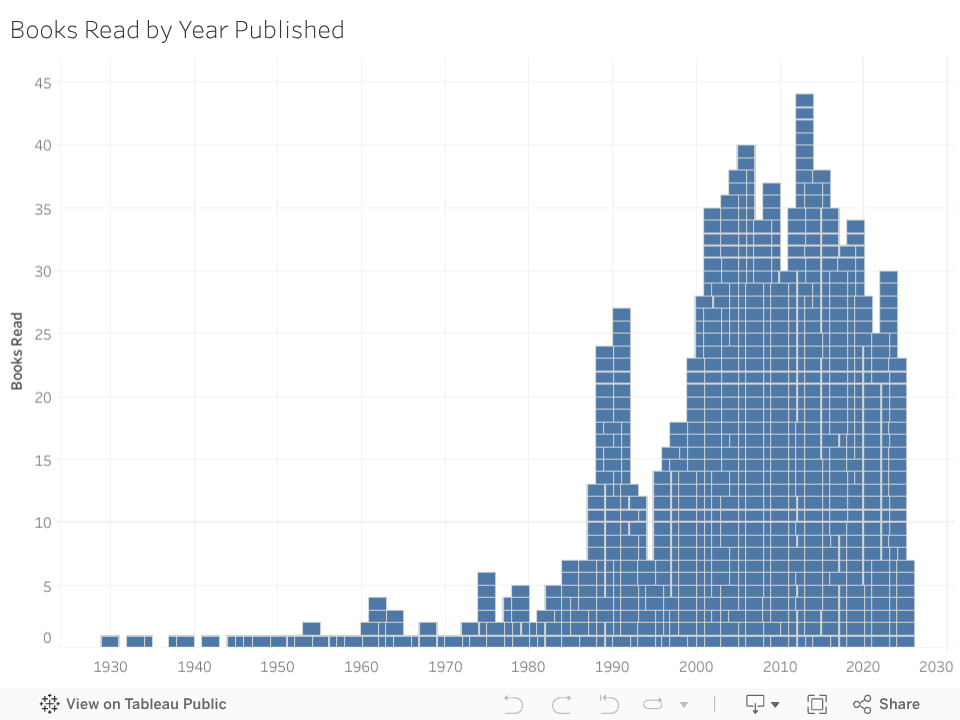
To date, I’m getting close to having read 1,100 books, and many of those were read before I started tracking in 2013. For the following chart, you can hover over any of the boxes by the year the book was published to see the book title, author, and my rating (if available). Earlier entries often lack ratings. This interactive chart is one of the great aspects of using Tableau.

My Goodreads Data Story: Dashboards, an Interactive Chart, and 5-Star Recommendations Read More »
business card json

Look What I Made with AI Art (prompt included so you can too)

Reading Time: 5 minutes

Reader Beware: Any blog post tagged as “Data Driven David” may not be as related to marketing as most of my content. I truly love data and love it even more when it is well visualized and wrapped in a great story — now, that’s good marketing.

Sometimes, you just need a little break from serious strategy and spreadsheets. That’s where creative AI prompts come in. Whether it’s a re-imagined Hot Wheels car, a retro-style McDonald’s Happy Meal, or a toy that never existed but totally should have, these images are all about having fun and letting your imagination run wild. Here are some of the images, along with their prompts, that I have had fun with.

Person Watching Themselves on TV

Create a photo of Green Arrow watching himself as a cartoon on tv. I created versions of this also for Jonah Lomu and Walter Payton, both who I think were the best at what they did and unfortunately passed away too young.

green arrow watching green arrow on tv
jonah lomu watching jona lomu on tv

JSON Business Card

ChatGPT Prompt: A close-up shot of a hand holding a business card designed to look like a {file_format} file open in {code_editor}. The card shows code formatted in {syntax_type} with keys like {key1}, {key2}, {key3}, and {key4}. The window includes typical toolbar icons and a title bar labeled {file_name}, styled exactly like the interface of {code_editor}. Background is slightly blurred, keeping the focus on the card.

Use the following for the variables {}
{file_format}: JSON
{code_editor}: VS Code
{syntax_type}: JSON
{key1}: “name”: “David Nelson”
{key2}: “title”: “Digital Marketer”
{key3}: “email”: “dave@marketingwithdave.com”
{key4}: “link”: “marketingwithdave.com”
[{key5}: “phone”: “911-867-5309”
{file_name}: Business Card.json or Business Card.xml

Cinematic Double Exposure Prompt

Create a cinematic double exposure of a man in profile, with a post-apocalyptic cityscape inside his silhouette. The inner scene shows the man walking through a destroyed, burning urban street, buildings in ruins, glowing embers and fire, with a dramatic sunset in the background. Moody lighting, warm tones, emotional and introspective mood, high detail, 8K resolution.

david nelson double exposure


High Contrast Close-Up Prompt

Generate a high contrast close up portrait of my face focusing on front head, in black and white, close-up, 35mm lens, 4kHD quality, giving proud expression, water droplets on my face, black shadow background only face is visible with profile looking sharper, ratio 4:3.

dave nelson shannon nelson high contrast

1969 RS SS Camaro HotWheels Prompt

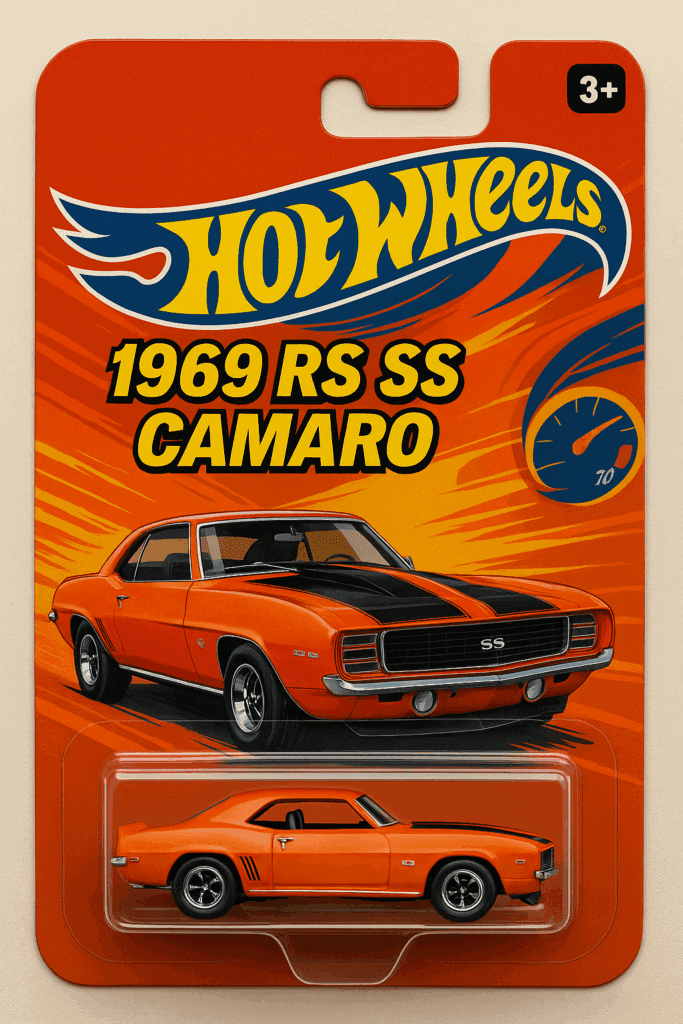
Design a realistic Hot Wheels blister pack featuring a 1969 RS/SS Camaro. The car should be painted in iconic Hugger Orange with black rally stripes. The packaging should include a clear blister showcasing the car, a bold and dynamic background with retro racing elements, and the classic Hot Wheels flame logo. Replace the usual “Hot Wheels” text with “1969 RS SS Camaro” in the same stylized font and positioning. The card backing should also include subtle nods to late-1960s design, such as muscle car graphics or a speedometer motif. Make it visually appealing for collectors, with attention to detail and a vibrant color scheme that highlights the Camaro’s aggressive styling.

1963 Corvette HotWheels Prompt

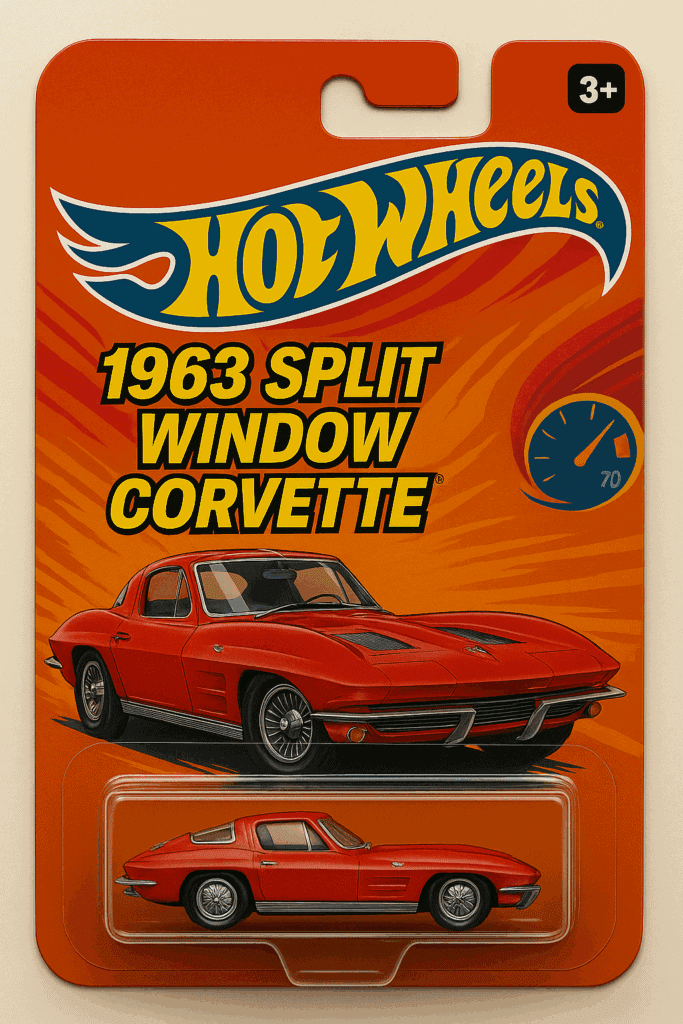
Design a realistic Hot Wheels blister pack featuring a 1963 Split Window Corvette. The car should be painted red. The packaging should include a clear blister showcasing the car, a bold and dynamic background with retro racing elements, and the classic Hot Wheels flame logo. Replace the usual “Hot Wheels” text with “1963 Split Window Corvette” in the same stylized font and positioning. The card backing should also include subtle nods to 1960s design, such as muscle car graphics or a speedometer motif. Make it visually appealing for collectors, with attention to detail and a vibrant color scheme that highlights the Corvette’s aggressive styling.

8-bit Pixel Art Prompt

Transform the attached photo into a front-facing 8-bit pixel art character, designed as if it were a sprite in a retro Nintendo game screenshot. Use a limited color palette and pixel grid typical of NES-era graphics.

Action Figure With Accessories Prompt

Draw an action figure toy (g.i. joe) of the person in this photo. The figure should be full figure and displayed in its original blister pack packaging. On top of the box is the name of the toy David Nelson with Digital Marketing Pro across a single line of text. In the blister pack packaging, next to the figure show the toy’s accessories including a laptop, iphone, diet mountain dew can, and a bar chart graph.

Superhero Prompt

Create a cartoon-style avatar based on this AI face. Style it like a comic book superhero, wearing a [clothing item, e.g., blue blazer], [position, e.g., arms crossed, standing confidently]. Keep the background clean.

Happy Meal Collectible Prompt

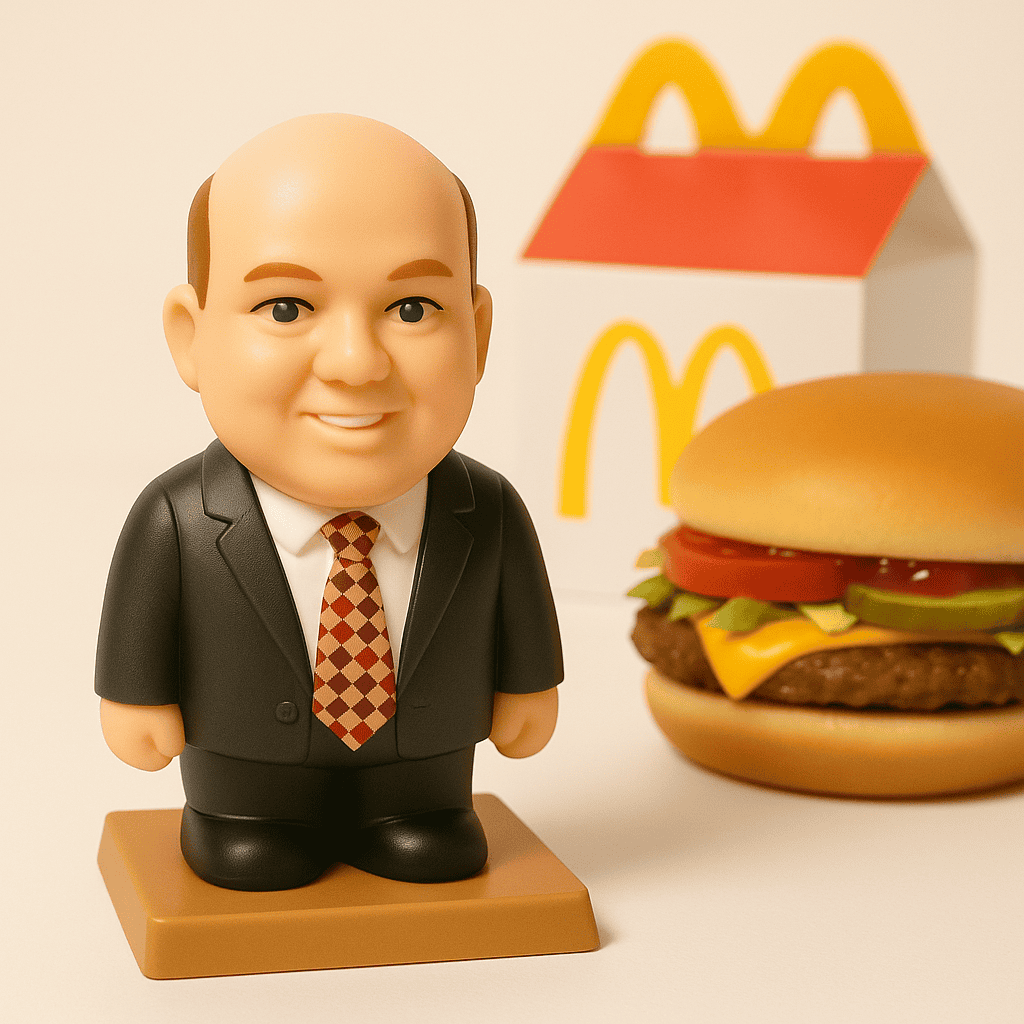
Transform the uploaded image into a collectible toy figure that could be included as a gift with a McDonald’s burger meal. Stylize the character as a small, plastic figurine placed on a simple display base. Include a realistic McDonald’s burger and its branded packaging in the background to give the impression of a Happy Meal toy promotion. Use soft lighting and a clean background, keeping the colors vibrant and playful.

Look What I Made with AI Art (prompt included so you can too) Read More »